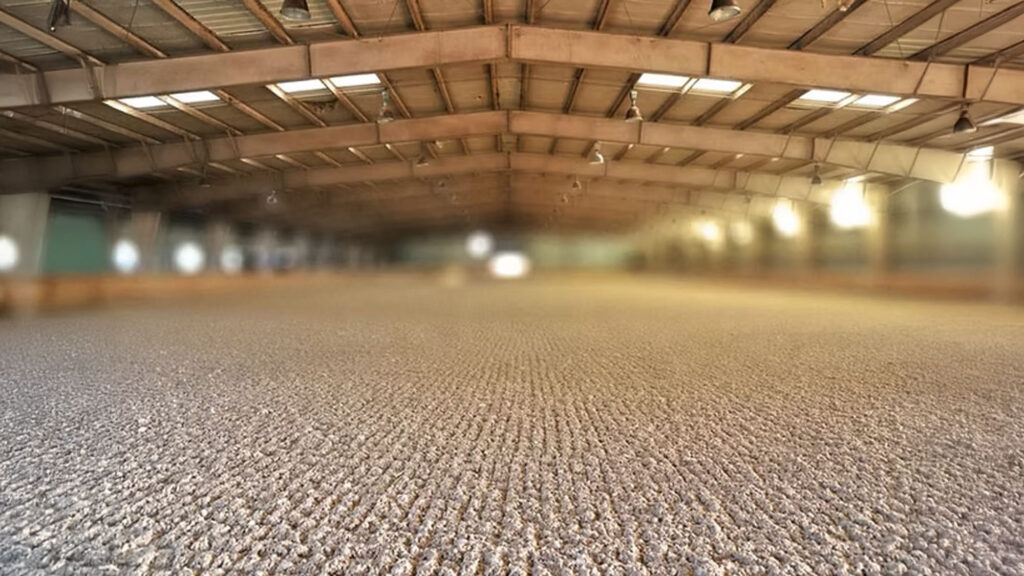
Installing footing for horse arenas involves more than choosing a riding surface and spreading it across the ground. The base, drainage, sand, additives, and maintenance routine all influence how the finished arena performs. Planning these elements together helps create a more consistent surface for everyday riding and training.
At GGT Footing, we believe a successful installation starts with asking the right questions. Whether you are building a new arena or improving an existing one, these five questions will help you understand your options and prepare for the work ahead.
Start with how you intend to use your arena. Your riding discipline, training schedule, indoor or outdoor setting, and local weather conditions should guide the conversation about materials. The goal is not simply to find a popular footing blend—it is to select a system suited to your arena and its maintenance needs.
Sand is a key component of many riding surfaces, but its characteristics matter. Particle size, shape, and grading affect how it interacts with textile additives and how the finished surface behaves. GGT Footing textile blends are designed to work with compatible sand to support stability, cushioning, and moisture retention.
Before choosing a blend, be ready to discuss:
For an existing arena, sharing sand reports or photos with the GGT Footing team is a useful starting point for a more specific recommendation. Do not assume that adding textiles alone will make unsuitable sand perform as intended.
Before installing the riding layer, evaluate what is underneath it. A typical arena system includes a prepared subgrade, a stable base, drainage suited to the site, and the footing layer above. Each part has a different job, and the surface depends on them working together.
The base provides structural support and helps maintain consistent footing depth. Drainage manages excess water. Textile additives can help manage moisture within the riding layer, but they cannot compensate for poor drainage or inadequate base construction.
Before materials arrive, have your arena builder or installation professional assess:
Addressing these questions before installation helps ensure the new footing rests on a suitable foundation rather than covering up unresolved problems.
There is no single material quantity or footing depth that suits every arena. The amount you need should be determined from the arena’s dimensions, the selected blend, the intended riding depth, and the existing materials you plan to retain. GGT Footing recommends selecting materials and planning depth around the arena’s intended use rather than treating every installation the same way.
For an existing arena, assessing the current sand is especially important. Its compatibility with the proposed textile blend should be evaluated before deciding what to add.
To prepare for a project-specific material estimate, gather:
Consistent depth matters after installation, too. Footing can move away from heavily used areas, so checking several locations gives a more useful picture than measuring a single spot.
Plan the material quantities and target depth with your footing supplier and installer before ordering, rather than relying on a generic recommendation.
For a sand-and-textile system, installation requires even distribution and thorough blending without disturbing the arena base. GGT Footing’s installation guide outlines a process that includes distributing the textile material, mixing it into the sand, watering, and rolling. The main steps are:
Equipment settings are particularly important. Mixing equipment and grooming tines must stay out of the base layer. Your installer should also follow the instructions supplied for your specific blend rather than treating every footing product identically.
Allow for an initial settling-in period. GGT Footing’s installation guide notes that the materials may take several weeks to fully mesh and develop the desired texture. Installation is therefore the beginning of learning how your arena responds to watering, grooming, and use—not the end of the process.
Include maintenance in your installation plan from the start. Even a well-built arena needs regular attention to preserve an even riding surface. Grooming redistributes material, watering manages moisture, and depth checks help identify areas where footing has shifted.
A practical routine includes:
Moisture management is especially important in water-dependent textile footing. Too little water can contribute to dust and reduced cohesion, while too much can produce heavy or unstable areas. Your watering schedule should reflect the installed blend, weather, and arena use rather than follow a fixed routine regardless of conditions.ggtfooting+1
Before installation, confirm that your facility has the water access, equipment, and staff time needed to care for the proposed surface. The right footing choice should fit both your riding goals and your ability to maintain it.
A successful arena installation brings together a suitable base, effective drainage, compatible sand and textiles, and a realistic maintenance plan. Choosing the riding layer is only one part of that system.
Contact GGT Footing to discuss your new arena or renovation. Share your arena dimensions, riding goals, and available sand information so our team can help you evaluate materials and plan your next steps.