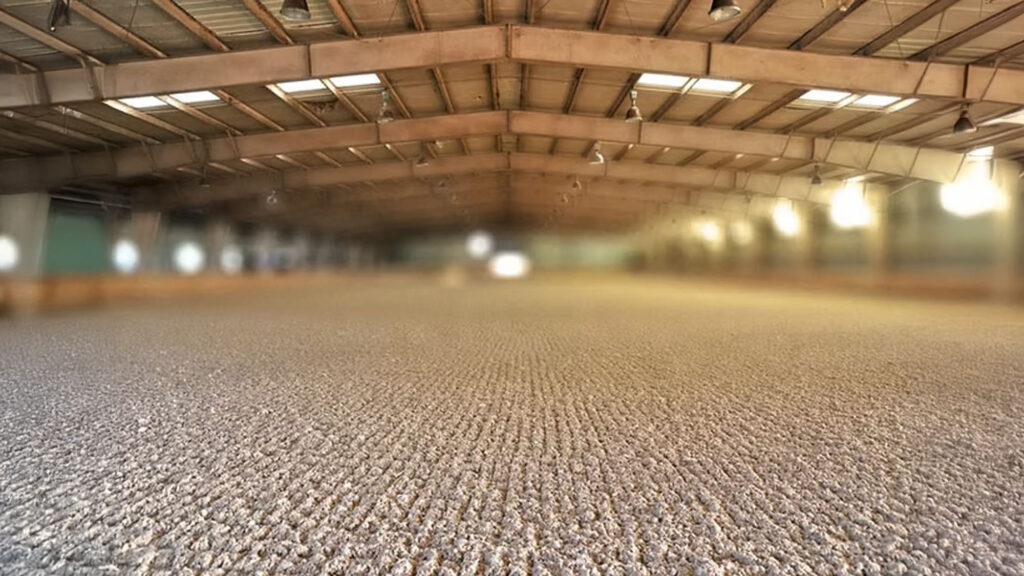
High-traffic equestrian facilities put intense, daily pressure on their arena surfaces. Boarding barns, training centers, and show venues need footing that stays consistent under heavy use, supports soundness, and doesn’t demand constant rework. The best footing for these environments is rarely plain sand; instead, it’s a purpose-built system that combines the right sand, high-quality additives, and a well-designed base to deliver durability and performance.
What “Best” Really Means for Busy Arenas
For high-traffic facilities, “best footing” is not just about how the arena feels on day one. It’s about how the surface behaves after hundreds of rides, intense weather swings, and ongoing maintenance. Key performance criteria typically include:
- Surface stability that resists deep spots, shifting, and rutting in high-use areas.
- Controlled cushioning and energy return that help protect joints and soft tissue.
- Consistent traction for multiple disciplines and levels of work.
- Low dust and manageable moisture needs for both health and comfort.
- Predictable maintenance that fits into a busy barn schedule.
When these factors are aligned, arenas ride more consistently, horses stay more comfortable, and barn managers spend less time fighting footing issues.
Why Sand Alone Is Not Enough in High-Traffic Facilities
Sand-only arenas can work in low-use environments, but heavy traffic quickly exposes their limitations. Without support from additives, sand tends to:
- Compact too tightly or break down into dust, depending on particle shape and quality.
- Shift and shear under repeated turns, creating holes, ridges, and uneven depth.
- Lose moisture rapidly, leading to dust and variable footing conditions.
In high-traffic barns, these issues often mean more frequent watering, constant dragging, and periodic emergency repairs. Over time, the labor and material costs of “cheap” footing can surpass the investment in a carefully engineered system.
Comparing Common Footing Additives for Busy Arenas
Several types of footing additives are used to upgrade basic sand, each with its own strengths and limitations in high-traffic settings:
- Rubber additives: Provide cushioning and reduce concussion but do little for shear strength or moisture retention. They can migrate to the top of the surface, creating inconsistent traction.
- Organic materials (wood chips, sawdust, fibers with organics): Initially improve cushion and moisture but break down over time, increasing dust and requiring frequent replenishment.
- Coated sands or waxed systems: Offer good stability and dust control, but often come with higher upfront costs and require careful installation and climate-appropriate selection.
- Synthetic textiles and fibers: When blended with suitable sand, they create a stable matrix that improves shear strength, moisture management, and long-term consistency—making them particularly well-suited for high-traffic facilities.
For barns that see constant use, synthetic textile and fiber systems stand out because they address multiple performance demands at once rather than solving just one issue, like cushion or dust.
Why Textile-Reinforced Sand Excels in High-Traffic Arenas
Textile-reinforced footing systems are designed to keep the upper portion of the arena surface connected and elastic. When properly mixed into compatible sand and supported by a good base, textiles and fibers help:
- Improve shear strength: The footing resists sliding out from under the hoof, reducing deep tracks and “rolling” under pressure.
- Enhance stability at depth: Horses work on a consistent platform rather than punching through to unstable layers.
- Promote even moisture distribution: Fibers help hold water in the profile, which supports compaction and minimizes dust.
- Maintain ride quality over time: The footing is less prone to rapid degradation or separation of materials.
For high-traffic barns, this means the arena continues to ride predictably throughout the day and from week to week, rather than feeling “good in the morning” and “bottomless by afternoon.”
Key Considerations When Choosing Footing for Busy Facilities
Selecting the best footing for a high-traffic arena involves more than picking an additive from a list. To get the most out of any system, consider:
- Sand quality: Angular, well-graded sand is critical for good interaction with textile or fiber additives.
- Base and drainage: A strong, well-drained base ensures the footing layer can perform as intended and withstand heavy use.
- Climate and water access: Choose a system and maintenance plan that match your region’s conditions and your facility’s ability to water and groom consistently.
- Primary disciplines and riding volume: Jumping, dressage, western performance, and lesson programs all load the footing differently and may call for slight adjustments in depth and composition.
When these elements are aligned, footing additives—especially textile and fiber blends—can help transform a busy arena from a constant maintenance project into a reliable, high-performance surface.