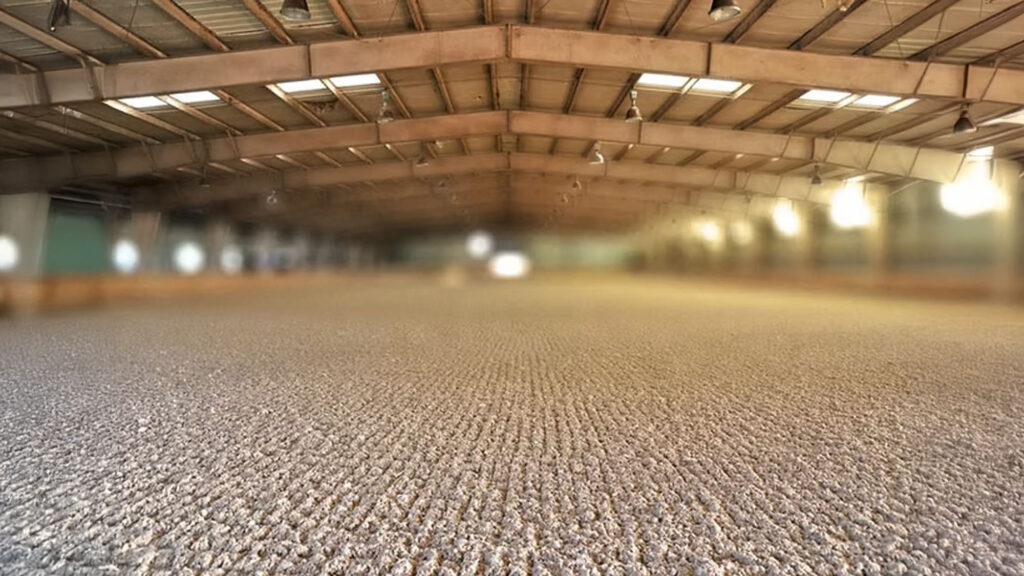
The best footing for horse arenas is not defined by one ingredient or a single “perfect” surface. It is defined by how the footing performs under horses: delivering reliable traction, appropriate cushioning, stability, and drainage through daily riding, changing weather, and consistent arena maintenance.
Whether an arena supports dressage, jumping, reining, hunter/jumper training, or general riding, the goal is the same: create a surface that helps horses move confidently and comfortably while giving riders a predictable feel underfoot.
Quality arena footing should provide enough traction for horses to push off, turn, stop, and land with confidence—without becoming overly gripping or slippery.
Too little traction can make a horse feel unstable, especially during turns, transitions, and landings. Too much traction can restrict natural movement and place unnecessary stress on joints, tendons, and ligaments. The best footing for horse arenas creates a balanced surface that allows the hoof to engage with the footing while still permitting a controlled amount of slide.
This consistency matters across the entire arena. A surface that feels deep near the rail, firm in the center, and loose in corners can interfere with training and make every ride less predictable.
Cushioning helps reduce the concussion that travels up the horse’s legs when hooves repeatedly impact the arena surface. While every discipline has different footing needs, a well-designed footing system should help soften impact without feeling excessively deep or unstable.
The right level of cushioning can support comfort during regular schooling and help create a more forgiving surface for activities involving repeated impact, such as jumping, loping, collected work, and lateral movements.
However, cushioning should not come at the expense of support. Footing that is too loose or deep may require horses to work harder, causing fatigue and making movement feel less efficient. The best arena footing combines softness at impact with a stable base that supports the horse through each stride.
A horse arena should feel consistent from one end to the other. Stable footing helps horses maintain balance and gives riders confidence in how the surface will respond during training.
Uniformity depends on several factors, including:
A carefully selected footing material can only perform as intended when it is part of a complete arena system. The base, footing depth, water management, and maintenance routine all influence how stable the final surface feels.
For example, even premium footing can become inconsistent if it is not watered appropriately, if the base is poorly constructed, or if dragging causes material to build up along the rail.
Drainage is one of the most important qualities of a dependable outdoor arena. When water cannot move through and away from the surface properly, footing can become muddy, compacted, slippery, or uneven.
A well-draining arena helps riders return to work sooner after rain and can reduce the long-term effects of standing water on the footing and base. Proper drainage also supports more consistent moisture levels, which helps maintain the footing’s traction and cushion.
Good drainage is not just about the footing material. It begins below the surface with site preparation, grading, base construction, and drainage design. For the best long-term results, footing should be selected with the entire arena system in mind.
Water plays an important role in arena performance. The right amount of moisture can help control dust, improve cohesion, and create a more stable riding surface.
Footing that dries out too quickly may become dusty, loose, or inconsistent. On the other hand, a surface that holds too much water can become heavy and compacted. The best footing for horse arenas works with a thoughtful watering program to maintain more dependable conditions.
Fiber-blended footing products can help improve moisture retention and stability by helping footing particles work together. This can contribute to a more consistent surface while reducing separation between materials over time.
Dusty footing affects more than arena appearance. It can reduce visibility, make riding less comfortable, and create respiratory concerns for horses, riders, trainers, and barn staff.
A quality footing system should help minimize airborne dust when properly maintained. Moisture management is essential, but footing composition also plays a role. Materials that retain moisture and maintain cohesion can help reduce dust while supporting the surface properties riders need.
For indoor arenas especially, dust control should be a major consideration when choosing footing. An arena that feels good to ride in but produces excessive dust may not support the long-term comfort of the people and horses using it.
No arena footing is completely maintenance-free. Even the best footing for horse arenas needs regular care to stay level, consistent, and safe.
The ideal footing system should be manageable for the facility’s available equipment, watering capabilities, riding schedule, and budget. Before choosing a footing, consider how often the arena will be used, which disciplines it will serve, whether it is indoors or outdoors, and who will handle maintenance.
A practical maintenance program often includes:
When footing, base construction, and maintenance practices are aligned, the arena can deliver a more consistent riding experience day after day.
The best footing for one horse arena may not be the best choice for another. A private dressage arena, a busy lesson facility, an outdoor hunter/jumper ring, and an indoor reining arena can all require different surface characteristics.
Still, the strongest arena footing systems share the same fundamentals: balanced traction, supportive cushioning, stability, drainage, dust control, and maintainability. Evaluating these qualities can help horse owners and facility managers choose a surface designed for their horses, discipline, climate, and riding goals.
At GGT Footing, we understand that successful arena surfaces depend on more than a single material. Our footing solutions are designed to help create stable, consistent, and performance-focused riding surfaces for a wide range of equestrian disciplines.
Ready to improve your arena surface? Explore GGT Footing solutions to find a footing option that supports the way you ride.