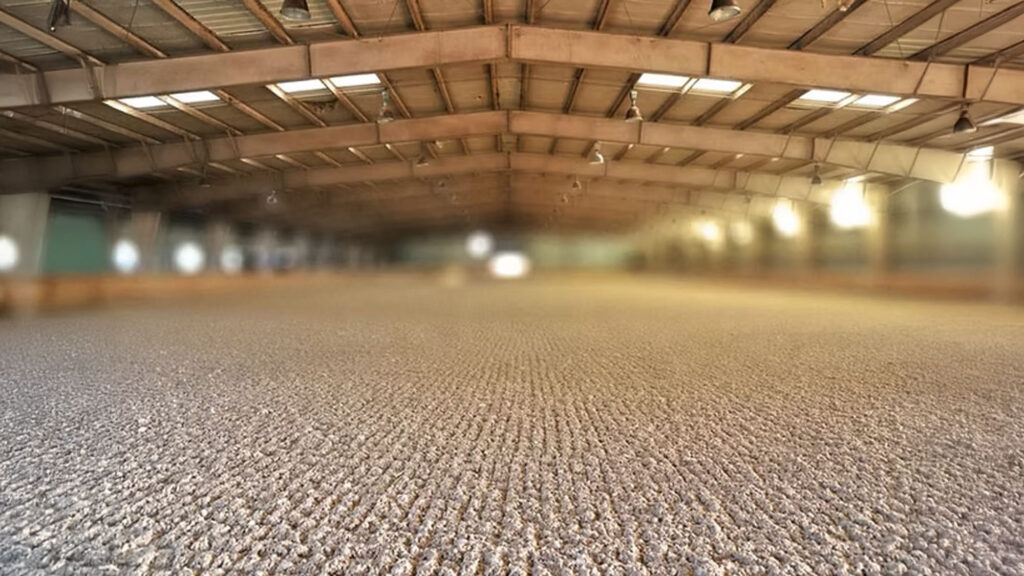
The track along the rail. A favorite schooling circle. The approach to a frequently used jump. Some areas of your arena work harder than others—and their footing can show it.
Repeated hoof traffic moves material out of well-traveled paths while compacting what remains. Over time, these areas can develop a different depth and firmness from the surrounding surface. Managing high-traffic areas on equestrian surfaces takes more than smoothing away visible hoofprints. It requires attention to footing distribution, moisture, grooming, and how riders use the space.
High-traffic areas vary with your discipline, lesson schedule, and training routines. Start by identifying where horses repeatedly travel, turn, take off, or land.
Common areas to monitor include:
Look beyond the most obvious hoofprints. A worn track may have less loose footing, while the area beside it has accumulated displaced material. Treating only the compacted track without redistributing that material leaves the underlying imbalance unresolved.
An arena can look freshly groomed without having a consistent footing depth. A smooth finish may hide shallow tracks, deeper edges, or compacted areas beneath the surface.
Include depth checks in your maintenance routine, comparing heavily used areas with less-traveled sections. Look for material collecting along the perimeter and places where the working layer has become noticeably thin. Your target depth should match your footing system and riding discipline rather than a single measurement applied to every arena.
Before adding more material, determine whether the existing footing needs redistribution. If material has simply migrated away from the track, adding footing across the entire arena may leave already-deep areas deeper still.
Effective grooming does more than erase hoofprints. It helps move displaced footing back into place and loosen compacted areas, keeping the working surface more uniform.
Choose equipment suited to your footing blend and adjust it to work within the surface layer without disturbing the arena base. Grooming too aggressively can damage the base or move excessive material away from high-use zones. Grooming too shallowly may leave underlying compaction unaddressed.
For better results:
Busy training and lesson arenas may need daily grooming—or more frequent attention during heavily scheduled use. A lightly used arena will have different needs. Let the condition of the surface guide your schedule instead of waiting for pronounced tracks to develop.
Grooming and moisture management work together. In fiber-blended equestrian surfaces, appropriate moisture helps the sand and textile components work together to support a stable, cushioned riding surface. Dry patches and overly wet sections can undermine that consistency.
Check moisture in high-traffic areas rather than assuming the whole arena matches the section nearest a sprinkler. Sun exposure, weather, irrigation coverage, and use can create different conditions within the same riding space.
Build your watering routine around regular observation:
The goal is an appropriately moist working layer—not simply a surface that looks wet immediately after watering.
Maintenance equipment cannot do all the work. How riders use the arena also affects where wear develops.
When training requirements allow, vary schooling locations and use more of the available riding space. Moving repetitive work away from the same track can help distribute wear rather than concentrating it in a few areas.
Practical adjustments include:
These changes complement regular grooming; they do not replace it.
A low spot that returns after every grooming session deserves a closer look. The same is true of persistent standing water, recurring hard patches, or areas that never seem to match the rest of the arena.
Repeated problems can warrant an assessment of drainage, surface grading, footing distribution, or the underlying base. Simply dragging the area again—or adding more material—may not address the cause.
If routine maintenance is not restoring consistency, consult your footing supplier or an experienced arena professional before making major changes. More extensive work, such as regrading or rebalancing the footing blend, should follow an assessment of the existing system.
High-traffic maintenance is easier to manage when it becomes part of everyday arena care. A practical routine includes:
The right routine should reflect your arena’s footing blend, workload, and environment. At GGT Footing, we encourage arena owners to pair appropriate grooming with consistent moisture management and close attention to heavily used areas. Contact our team to discuss your GGT footing system and the maintenance considerations for your facility.