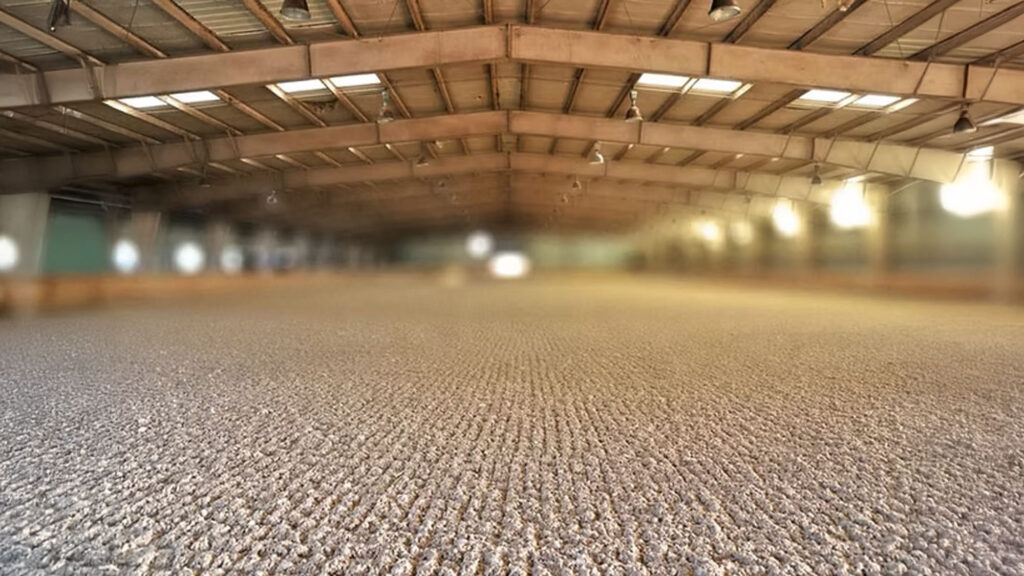
A dressage lesson in the morning, jumping practice in the afternoon, and recreational riding in the evening: a mixed-use arena needs to accommodate more than one training routine.
Choosing its surface takes more than finding a material labeled “all-purpose.” Different disciplines place different demands on traction, cushioning, stability, and how the hoof moves through the footing. A versatile surface should balance the needs of compatible activities without assuming that every discipline requires the same conditions.
When comparing equestrian surfaces, start with what happens in your arena. Then evaluate how the sand, additives, and maintenance plan can work together to support those activities.
Two multi-use arenas can have very different requirements. One might accommodate dressage, jumping, and general schooling. Another might combine recreational riding with western events that require a different surface response.
For example, dressage footing emphasizes lateral stability and appropriate cushioning, while jumping surfaces need support for takeoffs and landings. Reining may require controlled sliding in the upper layer—a different objective from maximizing grip.
Before comparing materials, list:
Use that list to establish priorities. Occasional use should be discussed, but it should not obscure the surface requirements of the work performed most often. GGT Footing’s selection guidance identifies primary discipline as a key consideration when choosing a blend.
A useful footing comparison starts with what you need the surface to do—not simply what the additive is made from.
A mixed-use arena needs a riding layer that supports movement without shifting excessively. Sand characteristics and compatible additives influence how that layer holds together. The goal is a supportive structure, not the hardest surface available.
A soft-feeling surface is not automatically the right surface. Cushioning must be balanced with support and stability so the footing suits the intended work. Different sand-and-additive combinations can be used to adjust those characteristics.
More grip is not always better. A surface designed to support jumping and turning may not provide the controlled release needed for specialized sliding work. Identify those differences early rather than assuming that a single blend can accommodate every activity unchanged.
An all-purpose blend should be evaluated as part of a complete system. Sand type, additive ratio, and moisture management all influence whether the surface delivers the intended feel throughout the arena.
An additive changes how the existing riding material behaves. That makes sand selection central to a meaningful comparison.
Particle size, shape, and gradation influence stability, drainage, and the feel of the surface. A blend recommended for one sand may not produce the same result in another.
Before discussing additive quantities or product options, establish:
For a mixed-use arena, this helps distinguish between a surface that needs fine-tuning and one whose underlying sand is poorly matched to its intended purpose. Compatible textiles can enhance an appropriate sand, but their selection should follow an evaluation of that sand.
“Textile footing” describes a category, not one identical riding surface. Fiber and geotextile proportions can vary, allowing different blends to target different surface characteristics.
GGT Footing offers discipline-focused products as well as competition, recreational, and custom options. Its custom blends allow the fiber-to-geotextile ratio to be tailored to the project, budget, and desired surface structure.
When comparing options, ask what each proposed blend is intended to change:
| Comparison point | Question to ask |
| Sand compatibility | Why is this blend appropriate for our sand? |
| Riding characteristics | How is it intended to balance support, cushion, and traction? |
| Discipline mix | Which activities does it accommodate, and where are the limitations? |
| Moisture requirements | What watering routine will help maintain the intended performance? |
| Customization | Would a standard blend or a tailored ratio better suit the facility? |
These questions make it easier to compare recommendations on their merits rather than choosing by product name alone. GGT Footing’s guidance emphasizes matching sand, additive ratio, and moisture management to the intended result.
Some activities fit naturally within an all-purpose footing plan. Others require a more careful discussion.
Dressage, jumping, and general schooling can often be considered within a balanced sand-and-textile system. However, specialized activities involving deliberate sliding may call for different upper-layer behavior.
That distinction matters when defining versatility. A surface can be adaptable without being suitable for every discipline.
If your program includes substantially different footing requirements, discuss whether:
Do not assume that changing grooming settings alone will resolve fundamentally different surface requirements. Establish what the proposed system can—and cannot—deliver before installation.
The most suitable blend is one your facility can maintain as intended.
Sand-and-textile systems depend on the relationship between material selection, additive ratio, and moisture management. Compare those requirements alongside the riding characteristics, not after the purchase decision.
For each proposal, request a clear explanation of:
Then compare those needs with your staffing, equipment, water availability, and lesson schedule. A mixed-use arena needs a workable care routine as much as a versatile blend.
A useful footing recommendation should explain why the proposed system suits your combination of activities.
Rather than asking only, “Which additive is best?” ask:
GGT Footing offers both standard and custom blends, providing options for facilities whose requirements do not fit a single discipline-specific category. The recommendation should connect those options to your arena’s actual use and desired surface structure.
The right equestrian surface for a mixed-use arena balances compatible riding needs while acknowledging its limits. It starts with suitable sand, uses additives selected for a specific purpose, and includes a maintenance plan that supports the intended performance.
At GGT Footing, we help arena owners explore textile blends for discipline-focused and all-purpose riding environments. Share your primary activities, existing materials, and maintenance resources with our team so the conversation starts with what your arena needs to do—not a one-size-fits-all promise.