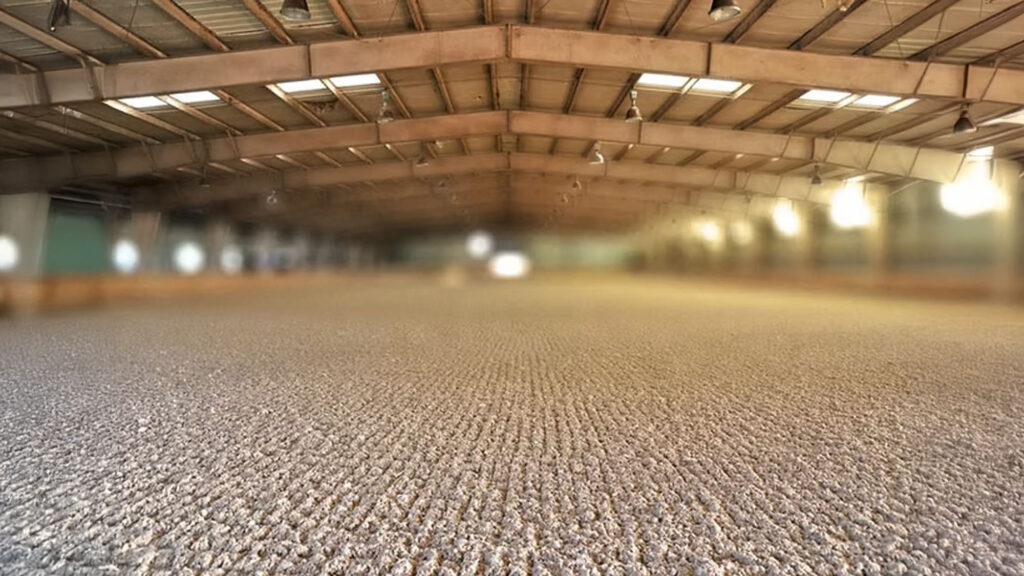
Keeping indoor arena footing in top condition is one of the smartest investments a barn owner, trainer, or facility manager can make. The right care extends the life of your surface, protects horses’ joints, and preserves a consistent ride feel that keeps clients happy and horses confident.
Before you can maximize longevity, you need a clear picture of what you’re working with. That means knowing:
When you understand how all these layers interact, you can tailor your maintenance routine instead of guessing. For example, a fiber-amended footing that’s designed to create stability and cushion will need different grooming and moisture management than plain sand. Taking the time to document your footing profile (materials, installation date, and supplier recommendations) becomes your baseline for every decision you make over the life of the arena.
Nothing shortens the life of indoor footing faster than inconsistent moisture. Too dry, and the footing becomes dusty, loose, and unstable; too wet, and it compacts, packs, and can become slick. The goal is a consistent moisture “sweet spot” from wall to wall and from top to bottom of the riding layer.
For many indoor arenas, this means:
Premium textile and fiber additives, such as those used in modern performance footings, are engineered to help retain moisture and hold sand particles together. When combined with a thoughtful watering plan, these materials help reduce dust, maintain resilience, and slow down the degradation of the sand itself. The result is less frequent top-ups, more predictable performance, and a riding surface that holds up through seasonal changes in humidity and temperature.
Grooming is not just about making pretty drag lines. Effective, footing-specific grooming keeps the surface uniform, prevents the formation of hard spots and deep tracks, and protects the integrity of the fiber and sand blend.
Key principles for extending footing life with grooming include:
Consistent grooming also helps redistribute material that naturally migrates to the sides and corners, which prevents thin spots in the center of the arena. When fibers and sand stay evenly mixed throughout the riding surface, the footing feels more predictable and wears more slowly over time. It’s also important to use an arena drag that pairs with your footing material. Geotextile and fiber additives like GGT Footing requires a fiber compatible arena conditioner.
How, when, and where horses travel over your arena has a direct impact on footing life. A jumping program that frequently builds complex courses in the same section of the ring will stress the surface very differently than a dressage program working mainly on flatwork and lateral movements.
To extend the life of your indoor footing:
By managing traffic thoughtfully, you allow the surface to “share the workload” across a larger footprint. This reduces the frequency of repairs, helps moisture stay more uniform, and prevents premature compaction in those familiar “problem spots” that every arena manager knows too well.
Even though indoor arenas are protected from direct rain and snow, they still feel every season. Winter air can be extremely dry, increasing evaporation and dust, while summer humidity and temperature swings can affect moisture retention and footing feel.
Seasonal strategies to extend footing life include:
Planning ahead for these shifts, rather than reacting to problems, helps keep your footing stable and predictable all year. Over time, this reduces material breakdown, helps fibers maintain their structure, and keeps your maintenance costs more predictable.
Even with excellent care, every arena surface eventually needs attention beyond regular watering and grooming. The key to extending footing life is recognizing early warning signs and choosing the least invasive solution that will restore performance.
Common indicators that your footing needs help include:
In many cases, a professional evaluation can confirm whether you simply need a material top-up, a blend adjustment (for example, adding quality textile fiber to stabilize an existing sand), or a more extensive renovation. Strategic upgrades—such as introducing engineered additives from a reputable manufacturer—can refresh a tired arena and significantly extend the useful life of your footing without the cost of a full rebuild.
A trusted footing partner is one of the most effective tools for maximizing your arena’s lifespan. Instead of relying on trial-and-error, you gain access to experience with thousands of arenas, a deep understanding of sand and fiber behavior, and product lines designed specifically to solve common performance and longevity issues.
Working with a specialist can help you:
For facilities that depend on safe, consistent training surfaces every day, this kind of guidance can be the difference between constant repairs and an arena that performs beautifully year after year. By combining smart material choices with disciplined maintenance and informed facility management, you can dramatically extend the life of your indoor horse arena footing while giving every horse and rider a surface they can trust.
If your arena is showing signs of wear or you are ready for a safer, more consistent surface, partnering with GGT Footing is the next step. Our textile and fiber additives are engineered to enhance cushion, stability, and moisture retention, helping you get more years of performance out of every load of sand. Connect with one of our experts today!