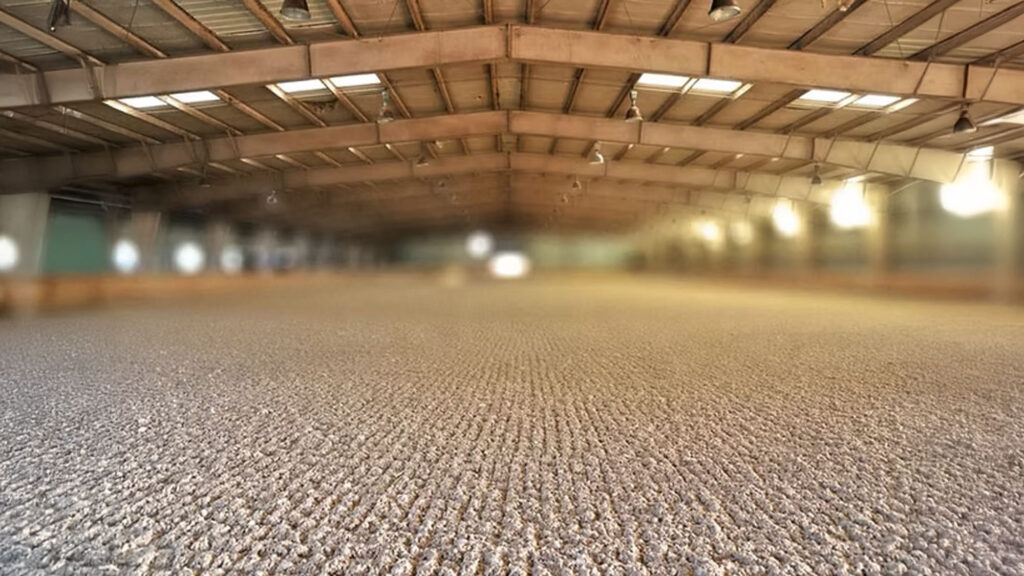
Your arena should provide support without feeling hard and unforgiving. But how can you tell when a supportive surface has become too firm?
Persistent hard spots, compacted high-traffic areas, and shallow footing that exposes the base are all reasons to investigate. These signs do not automatically mean you need new footing. They may point to uneven material distribution, moisture-management issues, or a grooming routine that needs adjusting.
The goal is balance: a riding surface that combines support, cushion, traction, and consistency. Here is what to look for—and how to address the cause rather than simply loosening the top layer.
Firmness describes how a surface responds to the initial impact of a hoof. Cushioning describes its ability to absorb forces as the horse loads the surface. A well-performing arena needs both appropriate support and cushioning, along with suitable grip and uniformity. Firmer does not automatically mean unsuitable, just as softer does not automatically mean better.
Your riding discipline, sand, textile blend, moisture level, and maintenance practices all influence that balance. For example, jumping surfaces may call for supportive takeoff and landing areas while still providing a consistent cushion. The objective is not to make the arena as soft as possible, but to create an appropriate, predictable surface for its use.
Pay attention to sections that repeatedly become packed down, particularly along the rail or in heavily used training areas. If those spots remain noticeably harder than the surrounding footing, compaction or uneven maintenance may be contributing to the problem.
Regular grooming helps redistribute material and break up compaction. When hard spots return quickly, review the maintenance routine and material blend rather than repeatedly treating the same patch.
A hard-feeling area may have too little riding material above the base rather than an overly firm footing blend.
Check the footing depth at several points, including the rail, corners, centerline, and frequently used jump approaches. Compare those measurements with the specifications for your particular surface. There is no reason to assume that adding the same amount of material everywhere will solve a localized depth problem. Consistent distribution matters alongside the total amount of footing.
Does the arena still have firm patches after appropriate watering and grooming? Does one section feel supportive while another feels packed and unyielding?
Persistent differences suggest that the surface needs a closer evaluation. Uneven moisture, inconsistent grooming, and differences in the footing blend can all affect performance across the arena. A freshly groomed appearance alone does not establish that the underlying surface is consistent.
Repeated use without suitable maintenance can leave compacted areas. Grooming helps redistribute footing and manage compaction, but its effectiveness depends on the equipment, settings, and frequency being appropriate for the surface.
Water affects more than dust. It also changes how a sand-and-textile surface holds together and responds underfoot.
More water is not always the answer to hard footing. In water-dependent GGT surfaces, increased watering combined with less harrowing can produce a firmer surface, while appropriate harrowing introduces air and changes its feel. Moisture and grooming therefore need to be managed together—not adjusted independently or by guesswork.
Sand provides the foundation of the riding layer, and its particle characteristics influence how the surface behaves. Textile additives need to complement that sand rather than compensate for an unsuitable material.
In What Makes GGT Footing Different, we explain how compatible sand and textile fibers work together to support stability, cushion, and moisture distribution. Adding fibers without first evaluating the existing sand may miss the underlying cause of poor performance.
The footing is only one part of the arena. Base construction, drainage, moisture management, and installation all influence how the finished surface performs.
If the same hard or uneven areas persist despite appropriate surface maintenance, the underlying system may need professional assessment. Our guide to equine arena footing, sand, textiles, and installation explains why those components need to work together.
Before ordering more material, establish whether the existing footing is evenly distributed. Check several locations rather than relying on a single measurement, and use your installer’s recommended depth for your arena system.
Where material has shifted, redistribution may be more appropriate than a full-arena top-up. Maintaining an even riding layer is an important part of consistent surface performance.
Look for differences between wet and dry areas, then review how watering and grooming affect them. Avoid assuming that a hard surface simply needs more water.
For water-dependent textile footing, the relationship between moisture and harrowing helps determine firmness. Make adjustments according to the recommendations for your installed blend rather than chasing a particular feel with water alone.
A maintenance routine should support the footing system you actually have. Regular dragging helps redistribute material and address compaction, while appropriate equipment setup makes that work more consistent.
Review your conditioner’s operating guidance before changing settings. GGT Footing’s arena maintenance resources include equipment setup, operation, and maintenance information.
If the arena remains too firm after suitable maintenance adjustments, have the existing sand and textile blend evaluated.
GGT Footing textiles are designed to work with compatible sand to stabilize the riding layer while maintaining cushion and rebound. The right solution depends on the existing materials, arena type, climate, and riding discipline—not simply adding more fiber or more sand.
Recurring compaction, persistent differences between areas, or a surface that no longer responds to appropriate maintenance are reasons to seek help. An assessment can consider the sand, textile blend, depth, moisture, and installation together instead of treating each symptom in isolation.
At GGT Footing, we evaluate factors such as your local sand, arena type, climate, and riding discipline to help identify a suitable footing solution. If your arena feels harder than it should, contact GGT Footing to discuss the existing surface and your options for improving it.