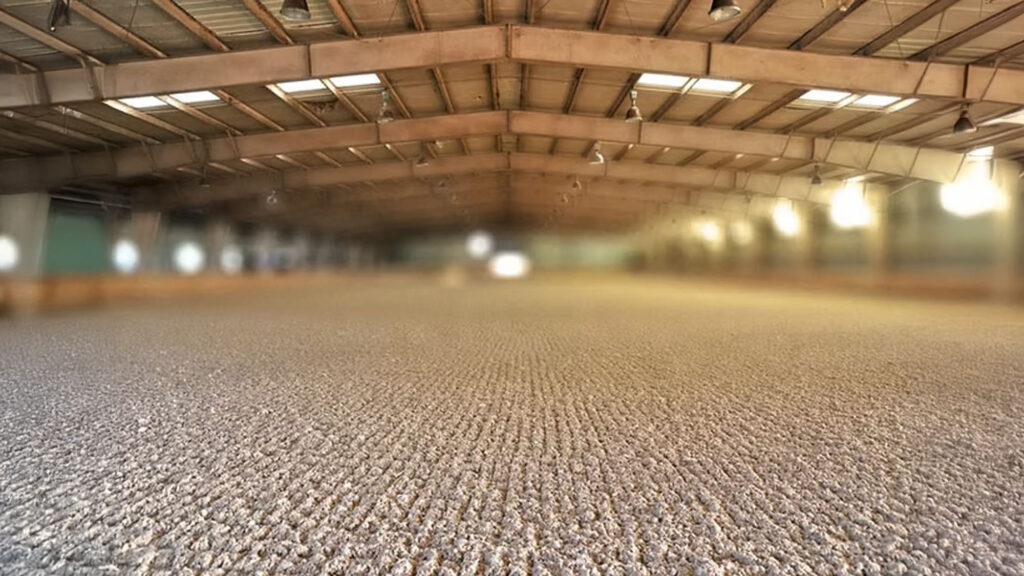
Designing a riding arena is a major investment in your horses’ soundness, your training goals, and your property’s long-term value. The footing you choose—and how you manage it over time—has a direct impact on performance, injury risk, and day-to-day rideability. A thoughtful footing plan will balance cushion, traction, and stability while staying realistic about budget and maintenance.
GGT Footing specializes in engineered textile additives and complete footing systems that transform basic sand into a consistent, high-performing surface. By pairing local sand sources with the right GGT Footing blend, arenas can achieve better stability, moisture retention, and longevity than sand alone.
Ideal riding footing should protect your horse’s joints and soft tissues while still allowing impulsion, push-off, and secure turns. Riders generally look for a surface that feels cushioned but not deep, with enough grip to prevent slipping without ever feeling “sticky.” Footing that is too hard increases concussion, while footing that is too loose or deep strains tendons and ligaments.
Consistency is just as important as feel. Horses and riders gain confidence when every stride is predictable, whether they are schooling a young horse on the rail or cantering a jump-off track. A well-designed footing system should minimize dead spots, slick patches, and sudden changes in depth from one area of the arena to another.
Every successful arena starts with a sound foundation under the riding surface. A typical arena section includes compacted subgrade, a properly graded and drained base, and then the footing layer on top. If drainage and base construction are poor, even the best footing materials will quickly become uneven, saturated, or compacted.
The footing layer itself usually consists of sand combined with one or more additives that control compaction, moisture, and cushion. This top layer is where GGT Footing systems focus, optimizing particle interaction so the surface shears slightly under the hoof, then quickly recovers. When each layer is designed as part of one system, arenas stay more uniform and require less emergency repair.
Not all sands behave the same under a horse. Particle size, shape, and gradation influence how the surface rides, how quickly it compacts, and how dusty it becomes. Rounded sands tend to roll and feel unstable, while sharp, sub-angular sands interlock better and provide secure traction. Very fine sands break down quickly and create dust, whereas carefully graded, washed sands generally perform more predictably.
Because local availability can be limiting, many facilities start by testing what nearby quarries can supply. GGT Footing can review sieve analyses and sample photos to help you understand whether a given sand will work on its own or if it needs support from textile additives. This approach helps you avoid expensive trial-and-error with unsuitable materials.
GGT Footing textile fibers and blends are designed to be mixed into compatible sands to improve stability, cushion, and moisture retention. The fibers help “knit” the sand together, reducing shifting and rolling under the hoof while still allowing the surface to break away slightly at impact. This creates a surface that feels more supportive, especially for disciplines that demand lateral work or quick turns.
Additives also influence how often you need to water and drag. Well-designed GGT Footing systems can hold moisture more evenly and resist rapid compaction, which reduces dust and extends the time between intensive grooming sessions. Over the life of an arena, this can mean lower maintenance costs and a more consistently rideable surface in every season.
Different disciplines stress footing in different ways, so arena design should always start with how the arena will be used. Jumpers and eventers need a surface that provides excellent support on landing and takeoff, with enough grip to allow confident turns to fences. Deep or unstable footing in jumping arenas can quickly lead to soft-tissue injuries or chipped confidence.
Dressage riders often prefer a slightly firmer, more elastic feel that allows the horse to push from behind and sit without slipping. Western disciplines such as reining or cow work may require a different blend and depth to enable controlled sliding without losing stability in other maneuvers. GGT Footing can help adjust fiber content, sand depth, and maintenance recommendations to suit the primary discipline—or to find a smart compromise in multi-use arenas.
Indoor and outdoor environments put different demands on footing. Indoors, dust control and air quality become major concerns, especially in cold climates where doors stay closed for long periods. A good sand and GGT Footing combination can hold moisture better and reduce airborne dust, making the arena more comfortable and healthier for horses and riders.
Outdoor arenas must contend with rain, sun, wind, and temperature extremes. Footing must drain well to avoid pooling and slop but also resist blowing away or drying into a hard crust. Thoughtful grading, base construction, and footing selection work together to combat these challenges. A tailored GGT Footing system can help maintain rideability through wet springs, hot summers, and freeze–thaw cycles.
Even the best footing system depends on consistent maintenance. Regular dragging helps redistribute material, break up minor compaction, and keep the surface uniform from wall to wall. The right drag pattern and equipment will depend on your footing blend, arena size, and usage patterns, but the goal is always the same: consistent depth and feel in every track.
Moisture management is equally important. Too little water increases dust and reduces cohesion; too much water can create slick, unstable areas. GGT Footing can provide arena-specific guidance on ideal moisture ranges and practical watering strategies, whether you rely on overhead sprinklers, water wagons, or automated systems. With a good schedule in place, daily maintenance becomes manageable and predictable.
If you are starting from scratch, you have the opportunity to design the full system—from subgrade to footing—with your long-term goals in mind. This is the ideal time to consider site placement, drainage, base construction, and the exact GGT Footing blend that will best serve your program. Proper planning at this stage often saves money and headaches for years to come.
Existing arenas with problematic footing can often be improved without a full rebuild. By analyzing your current sand, drainage behavior, and maintenance limitations, GGT Footing can recommend adjustments such as adding compatible textiles, resetting the depth, or improving grooming practices. Many facilities are able to transform inconsistent, dusty, or hard arenas into reliable training surfaces with a targeted retrofit.
Common warning signs that it is time to consult a footing specialist include chronic dust despite frequent watering, persistent hard spots or deep areas, repeated soft-tissue injuries, or riders feeling insecure about traction. If your arena changes dramatically with the weather or disciplines are constantly compromising on surface quality, expert input can make a significant difference.
A footing specialist brings experience with thousands of arenas, many sand types, and a wide range of climates and disciplines. Rather than guessing at additives or dragging patterns, you can use that expertise to move quickly toward a reliable solution. GGT Footing offers this level of support as part of its commitment to long-term arena performance.
Selecting the ideal sand and footing system for your horse arena does not have to be guesswork. GGT Footing can review your goals, discipline, climate, and regional sand options to recommend an appropriate sand profile and additive blend. Whether you are building a new arena or rehabbing an existing surface, a tailored GGT Footing system can help you achieve safe, consistent, and high-performing footing that supports your horses stride after stride.
To get started, contact GGT Footing to discuss your arena, share sand reports or photos, and schedule a customized footing consultation. With the right materials, design, and maintenance plan, your arena can become a reliable, confidence-building surface for every ride.