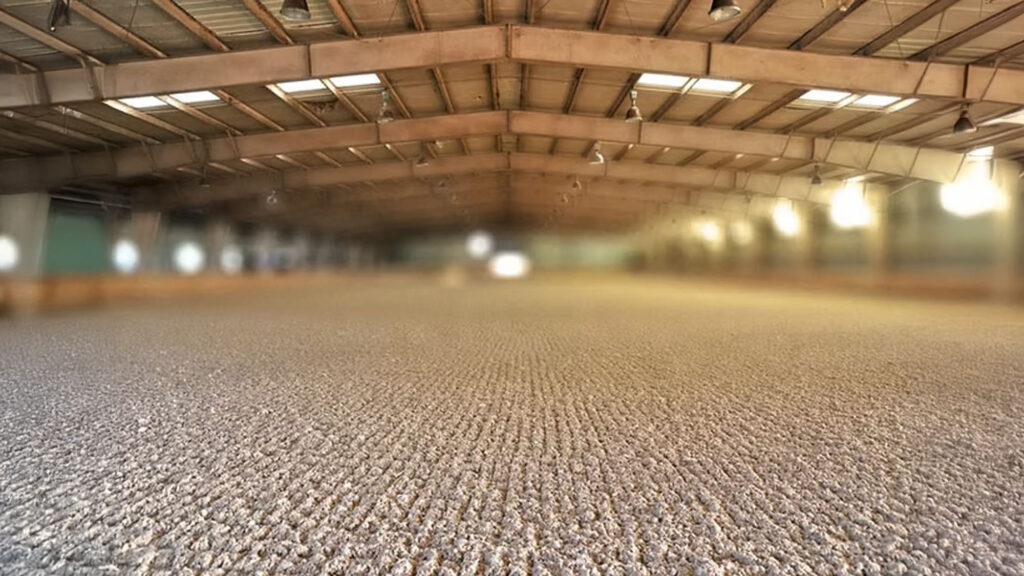
More riders than ever want the predictability and safety of a show-quality surface at home—without hauling to the ring multiple times a week. With the right design, materials, and maintenance, private arenas can deliver the same level of performance and soundness support found at top competition venues. This guide walks you through what “competition footing” really means, how systems like GGT Footing work, and how to build and maintain a surface that performs day in and day out.
What Makes Footing “Competition-Grade”?
Competition arenas aren’t just fancier—they’re engineered for consistency, safety, and performance under heavy use. While no single surface is perfect for every discipline, high-quality footing shares a few core traits:
- Stability: The surface should support the hoof without shifting unexpectedly under load.
- Cushioning and shock absorption: Enough give to reduce concussive forces on tendons, ligaments, and joints.
- Traction: Reliable grip for acceleration, turns, and landing without being sticky or slick.
- Consistency: Similar feel across the entire arena and from one day to the next, regardless of weather.
- Manageable maintenance: A surface that can be kept in good condition with a realistic routine for your facility.
For private arenas, the goal is to bring as many of these qualities as possible into a space designed for regular training, lessons, and occasional schooling shows.
Why Many Competition Arenas Choose GGT Footing
GGT Footing (German Geo Textile) is a widely used system in show venues and high-performance facilities. It blends high-quality sand with engineered geotextile fibers to create a stable, springy surface that mimics some of the best properties of good turf.
Key benefits for private, competition-style arenas:
- Improved stability: Fibers act like “roots” in the sand, reducing unexpected shear and sliding underfoot.
- Shock absorption: The fiber–sand matrix cushions impact, helping to minimize concussive stress on horse legs.
- Moisture retention: The textile holds water longer than plain sand, reducing dust and keeping the surface more consistent between waterings.
- Weather resilience: Synthetic fibers resist heat and UV, making GGT suitable for outdoor arenas in a range of climates.
- Customizable performance: Blends can be tuned for jumping, dressage, or all-purpose use by adjusting sand type, fiber ratio, and maintenance practices.
When installed and maintained correctly, GGT Footing can give private arenas a feel very close to what riders experience at major competition venues.
Designing Your Private Arena for Competition-Level Footing
Great footing starts with the base and overall arena design. Even the best surface material can’t perform if the foundation, drainage, or geometry are off.
1. Site Selection and Drainage
- Choose a location with natural slope or the ability to grade for runoff.
- Ensure water moves away from the riding surface to prevent pooling and mud.
- In wet climates, consider subsurface drainage systems or permeable base materials to speed drying.
Consistent drainage is one of the biggest differentiators between a “good enough” arena and a truly competition-ready one.
2. Base Construction
A proper base supports the footing and helps it perform consistently.
Typical layers include:
- Subgrade: Compacted native soil, graded for drainage.
- Base layer: Crushed stone or similar material to provide structural support and further drainage.
- Leveling layer: A finer material (often sand or sandy loam) to create a smooth, even platform for the final footing.
The loose footing material (sand plus any additives like GGT fibers) sits on top of this system and must “knit” to the base so it doesn’t slide freely as horses work.
3. Surface Footing Design
Work with an experienced footing supplier or installer to choose:
- Sand type: Particle size and shape affect traction, cushion, and stability.
- Footing system: Plain sand, sand with fiber additives, or an engineered system like GGT.
- Depth: Most riding surfaces perform best with 3–4 inches of loose footing over a well-compacted base.
For private arenas aiming for a competition feel, many owners opt for a fiber-reinforced system from the start rather than trying to “fix” a poor base sand later.
Installing GGT Footing in a Private Arena
Installation is where design meets reality. Proper installation ensures the fibers and sand work together as intended.
Step 1: Prepare and Level the Base
- Clear vegetation, rocks, and debris.
- Grade and compact the base to the designed slope and crown.
- Laser-grade the surface if possible to achieve a consistently level platform.
Step 2: Place and Condition the Sand
- Spread the chosen sand evenly across the arena.
- Water and drag to achieve the desired compaction and moisture before adding fibers.
Step 3: Mix in GGT Footing
- Distribute GGT Footing textiles evenly over the sand surface according to the manufacturer’s rate.
- Use a harrow or arena conditioner to thoroughly blend fibers into the top several inches of sand.
- Water again to help fibers integrate and to reduce dust during mixing.
The result should be a uniform blend where fibers are dispersed throughout the sand profile, not just sitting on top.
Step 4: Fine-Tune for Your Discipline
- For jumping: Slightly firmer take-off and landing zones with consistent cushion in between.
- For dressage: Even, stable footing with enough grip for lateral work and controlled slides.
- For all-purpose: A balanced blend that supports both flatwork and low-level jumping.
A knowledgeable installer can help adjust the blend and initial maintenance plan to match your primary use.
Maintaining a Show-Ready Surface at Home
Competition footing isn’t “install and forget.” Regular maintenance keeps the surface safe, consistent, and performing as designed.
Daily and Weekly Care
- Drag or harrow regularly: Redistributes material, breaks up compaction, and maintains even depth.
- Water as needed: Keep the surface evenly moist to control dust and maintain fiber performance.
- Remove manure and debris: Prevents contamination and uneven moisture retention.
For GGT Footing specifically, consistent dragging helps keep fibers evenly distributed, which is critical for stability and rebound.
Common Mistakes to Avoid
Even well-intentioned projects can fall short if key details are overlooked.
- Skipping proper base work: No surface can perform long-term on a poorly drained or uneven base.
- Choosing sand alone for high-performance use: Plain sand may work for light riding but often lacks the stability and cushion needed for serious training.
- Inconsistent maintenance: Irregular dragging and watering lead to hard spots, dust, and unpredictable footing.
- Ignoring discipline needs: A surface that’s too deep or too firm for your primary work can affect performance and soundness.
Working with a footing specialist from the design stage can help you avoid these pitfalls and get closer to a true show-quality feel.
Is Competition Footing Right for Your Private Arena?
If you’re training multiple horses, preparing for shows, or simply want a safer, more predictable surface at home, investing in competition-grade footing can pay off in performance and soundness.
GGT Footing and similar systems are especially appealing for private arenas because they:
- Deliver consistent, high-performance characteristics across seasons.
- Reduce the need for constant re-working compared to some traditional surfaces.
- Scale well from small dressage courts to large jumping fields.
The key is to match the system to your climate, discipline, budget, and maintenance capacity—with professional guidance where it counts.
Bring the Show Ring Home
You don’t need a grand prix venue to enjoy competition-level footing. With thoughtful design, quality materials like GGT Footing, and a realistic maintenance plan, private arenas can provide a safe, consistent, high-performance surface every time you ride.
Start by evaluating your current base and surface, then talk to a footing specialist about how to move from “good enough” to truly show-ready at home.