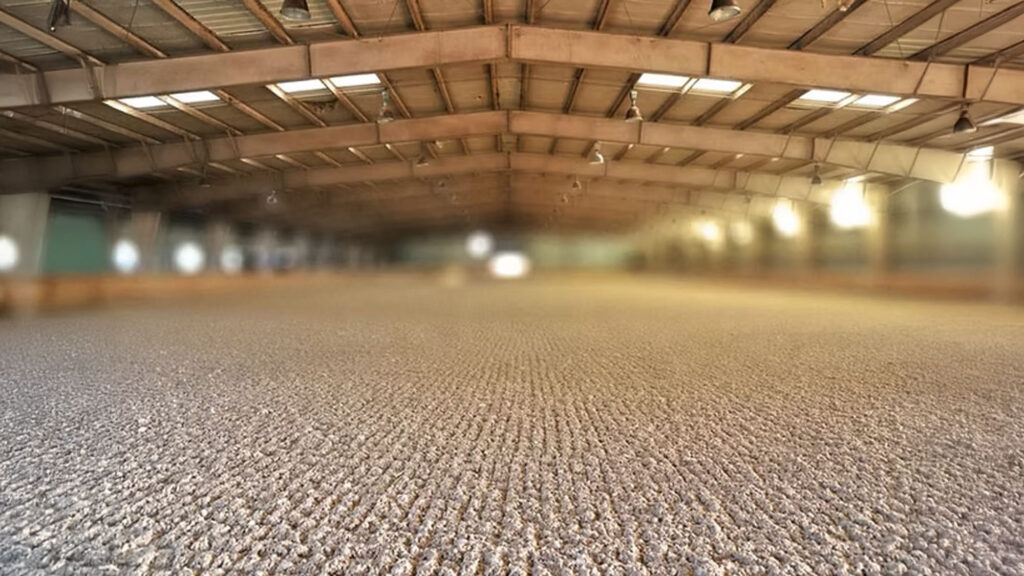
A freshly groomed arena can look ready for anything. The more useful question is how it performs halfway through your training day. Does the rail stay supportive after several lessons? Do frequently used corners feel similar to the center? Can your team restore the surface between sessions without disrupting the entire schedule?
The best footing for horse arenas should suit the way your facility actually trains—not just look good immediately after the drag passes. Sand selection, compatible textile additives, base construction, and maintenance all contribute to a predictable riding surface.
Instead of comparing footing ingredients alone, consider how your arena supports a complete training cycle: preparation, schooling, maintenance, and the next ride.
Before choosing footing, describe a typical week at your facility.
An arena used for a few private rides has different demands from one hosting back-to-back lessons, flatwork sessions, and jumping exercises. Riding volume and discipline influence the blend, depth, and maintenance an arena may need.
Create a practical training profile that includes:
Use this profile when discussing footing options. “We need dependable footing for six consecutive lessons” gives a supplier more useful context than “We want something soft.”
The aim is to choose a surface and care routine that fit your operation together. Even a well-designed blend requires a maintenance plan your team can realistically follow.
A single inspection cannot show how the surface responds throughout a working day. For a more useful comparison, observe the arena at three points.
Walk the arena after normal preparation. Note uneven material, wet and dry patches, and areas that require extra attention.
This establishes a starting point. Without one, it is difficult to distinguish a preparation issue from a change that develops during use.
Check high-use areas between sessions when it is safe to do so. Look for material displacement along the rail, changes around repeated exercise locations, and differences between busy and lightly used sections.
The purpose is not to expect an untouched surface after every horse. It is to understand where the arena changes and whether those changes fit the maintenance routine you can provide. High-traffic footing needs to be evaluated by its performance under repeated use, not just its day-one appearance.
Observe how the surface responds to its normal reset. Does appropriate grooming redistribute the material effectively? Are persistent problem areas receiving a closer assessment, or simply being smoothed over?
GGT Footing recommends fiber-compatible conditioning equipment with spring tines and a roller to keep sand and textiles mixed together. Equipment settings should suit the installed footing and avoid disturbing the base.
Reliable traction matters during turns, transitions, approaches, and changes of direction. But choosing footing is not a contest to create the grippiest possible surface.
Traction needs to work alongside cushioning and stability. The appropriate balance depends on the riding discipline and how the arena is used.
For your training program, focus on consistency across the places horses work:
These observations give an arena professional specific issues to investigate. They are more useful than describing the whole arena as “too slippery” or “too hard” without identifying where and when the problem occurs.
Inconsistent footing adds another variable to a schooling session. When one end of the arena is deep and another is firm, riders may need to adjust to the surface rather than concentrate on the exercise. GGT Footing’s guidance on daily training identifies uniformity as an important part of a predictable riding environment.
That makes uniformity a useful selection criterion—not just an ongoing maintenance goal.
Ask a footing professional how the proposed system will address your facility’s conditions:
The answers should connect the material recommendation to daily operations. A footing proposal is more useful when it explains how the surface will be maintained, not simply what will be installed.ggtfooting+1
GGT Footing combines compatible arena sand with engineered textile fibers. The fibers help stabilize the sand and support cushioning, traction, and moisture retention within the riding layer.
For regular training, that structure can help address the shifting associated with loose sand alone. However, textile footing is not a stand-alone solution for every arena. Its suitability depends on the sand, drainage, climate, workload, and riding goals.
Think of textile fibers as one component of a coordinated system:
This is why adding fibers should follow an evaluation of the arena rather than serve as an automatic response to every footing concern.
The right surface must fit the time, equipment, and staffing available to care for it.
Before committing to a footing system, work out when maintenance will happen. A facility with a long midday break has different opportunities from one running uninterrupted evening lessons. A private owner may handle all watering and grooming alone.
Discuss these practical questions during planning:
Maintenance demands vary with arena use. GGT Footing emphasizes choosing a plan that is realistic for the facility rather than assuming the same routine suits every owner.
A surface that fits your maintenance capacity is a stronger long-term choice than one selected on appearance or product claims alone.
The best footing for horse arenas is not defined by one ingredient or a freshly groomed finish. It is a system suited to your discipline, workload, environment, and maintenance resources.
For consistent training, evaluate what happens throughout the day: how the arena is prepared, how it responds to repeated use, and how it returns to working condition.
At GGT Footing, we help arena owners explore sand-and-textile solutions suited to their riding goals and facility needs. Bring your training schedule, maintenance capabilities, and surface observations into the conversation so the recommendation starts with how your arena will actually be used.