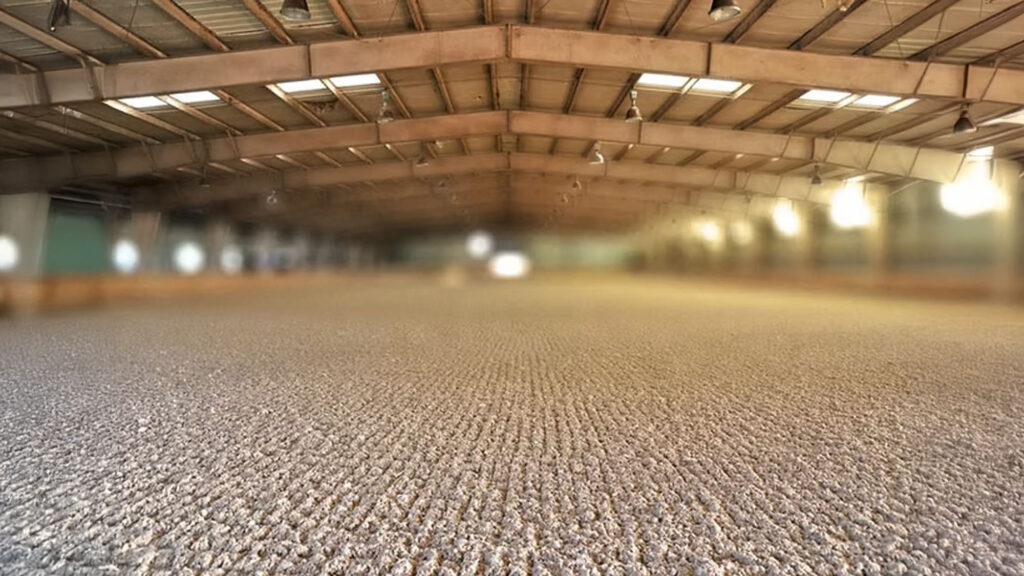
Consistency is one of the most important qualities of a well-performing equestrian surface. Horses and riders rely on the arena to feel predictable from stride to stride, whether they are schooling at home, preparing for a show, or competing at a high level.
When horse arena footing changes from one area to another, horses may need to adjust their movement unexpectedly. A surface that feels firm in one corner, deep along the rail, loose in the center, or slippery after watering can affect confidence, balance, and the quality of each ride. Consistent footing helps create a safer, more dependable environment for horses and riders across disciplines.
Consistent horse arena footing does not necessarily mean the surface feels hard or identical in every condition. Instead, it means the footing responds predictably and provides a uniform level of traction, cushioning, and stability throughout the arena.
A consistent surface should help a horse:
For riders, consistency makes it easier to focus on training goals rather than wondering how the footing will feel in the next corner.
Footing can become inconsistent for many reasons. Uneven footing depth, poor moisture distribution, a compromised base, inadequate drainage, or improper dragging can all create areas that perform differently.
For example, footing that is deeper along the rail may make horses work harder through corners. Loose material can reduce stability, while compacted areas may feel firmer and provide less cushioning. In an outdoor arena, rain and drainage issues can create wet spots that change traction and make the surface unpredictable.
These changes may be subtle at first, but they can affect the quality of training over time. A rider may compensate by avoiding certain areas of the arena, while a horse may hesitate, lose rhythm, or feel less confident in turns, transitions, or landings.
Traction and stability work together to help horses move comfortably and confidently. Horses need enough traction to push off, turn, stop, and land, but the footing should not grip the hoof so strongly that it restricts natural movement.
When arena footing is consistent, the hoof encounters a more predictable response with every stride. This helps reduce sudden changes in resistance that can disrupt balance. It also allows riders to better assess how their horses are moving, since the arena surface is not introducing new variables from one section to another.
Stable footing can be especially important in areas that receive frequent use, including takeoff and landing zones, corners, rail lines, and the center of the arena.
Horses learn from repetition. When the arena surface provides a dependable feel, horses can focus on their work rather than reacting to unexpected changes underfoot.
This is particularly valuable for young horses, horses returning to work, and horses developing confidence over fences or in more demanding flatwork. A uniform surface allows them to build trust in their environment and move forward with greater relaxation.
Riders benefit as well. Whether working on a precise dressage movement, riding a reining pattern, or approaching a jump, a predictable surface supports clearer decision-making and more confident riding.
Footing consistency is the result of both material selection and regular arena care. Even high-quality footing needs the right base, moisture level, and maintenance plan to perform at its best.
Several factors can influence arena uniformity:
Regular monitoring can help facility owners identify issues before they affect the entire arena. Checking footing depth, watching how water moves across the surface, and observing high-traffic areas are simple ways to maintain a more consistent riding environment.
A consistent arena begins with a footing system selected for the facility’s discipline, climate, use level, and maintenance capabilities. It also requires a routine that keeps footing depth, moisture, and surface conditions under control.
To support consistency in your arena:
GGT Footing textiles can help arena owners create surfaces designed for enhanced stability, moisture management, and performance. When paired with proper installation and maintenance, fiber-blended footing can support a more uniform riding experience across the arena.
Horses perform their best when they can trust the surface beneath them. Consistent horse arena footing supports dependable traction, stability, cushioning, and confidence—whether the day’s work involves a quiet training ride, a busy lesson schedule, or competition preparation.
At GGT Footing, we help horse owners and facility managers build and maintain arena surfaces that support their goals. Contact us today to get started.